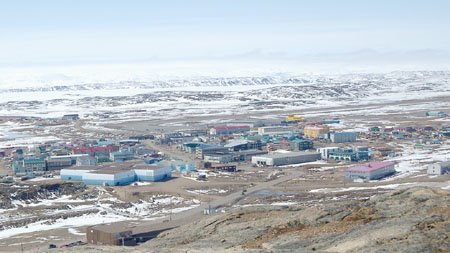
I have been busy all summer. There hasn't been much time to blog anything. This summer was full of family activities, BBQ's, campfires, fishing, berry picking and a few frosty beers. The fish didn't come until late July this year. The ice had all melted earlier this year and made fishing in July a bit safer and easier. I hooked a very large char late in July. We threw it on the BBQ soon after I had caught it. This fish fed 8 people and there was plenty left over. I do not know how much the char weighed in at but it was about 29 to 30 inches in length. I would say that all in all a total of 60 fish were caught in July. Most of the char was hung out to dry in the persistent arctic sun. This dried char is a favourite among the local crowd here.
In the first week of August, a deck was built in behind my inlaws house. The deck is about 150 square feet of unfinished 2 x 4 lumber. It juts out over the hillside above the shore of Frobisher Bay. The view is awsome. We hope to enjoy the deck for many years to come. I will get some pics posted as soon as I get a new camera.
The blueberries are ripe and the picking is still good. Baffin Island is covered in blueberries and black berries. The arctic varieties are smaller than the southern counterparts but just as tastey. Blue berry pancakes, blue berry muffins, blue berry pie and blue berry jam make August a special month.
People have been digging up buckets of clams during the lowest tides. Frobisher Bay has up to 12 meter tides. When the tides are in the range of 10 meters high and 1 meter low, this is the time to take a boat out to the clam beds. The arctic clams have to be caught one at a time. The people use garden tools to dig up the clams as they find them at the low tidal pools. The clams are tastey and plentiful. I don't mind them raw but prefer to make a clam chowder at home with them. The digging is hard and cold even in the mid summer. It is wise to take a warm parka with you when you go boating on Frobisher Bay.
Golfing on the tundra is still a favourite with the local men. The "course" was always busy this year and still loads of fun to play. The Canadian Military have been here doing some war games and stuff. They also had a chance to take a shot at my tundra golf course. The verdict? They loved it. HooWa. No fairways, no out of bounds and no trees. I think that they all enoyed the golfing. I know that this year, I had played a few very good rounds. I think that we should build a new course though. It would be nice to have a change in scenery while playing. It'll have to wait though. The snow is on it's way. It is getting dark and cold. Another arctic winter. I wonder what it will bring me this time around?
Sunday, September 10, 2006


Sunday, May 21, 2006
Sunday, April 09, 2006
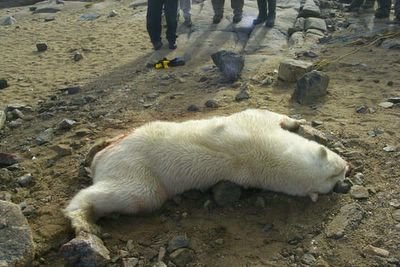
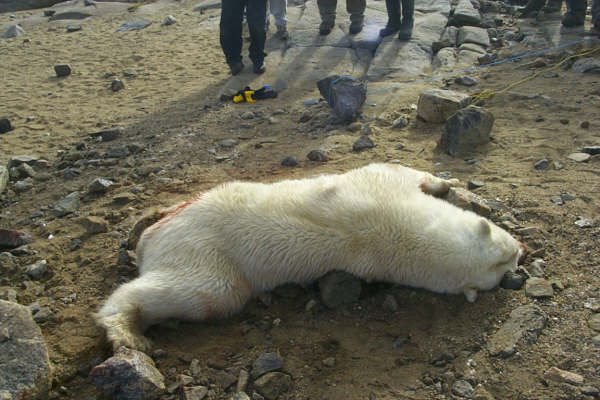
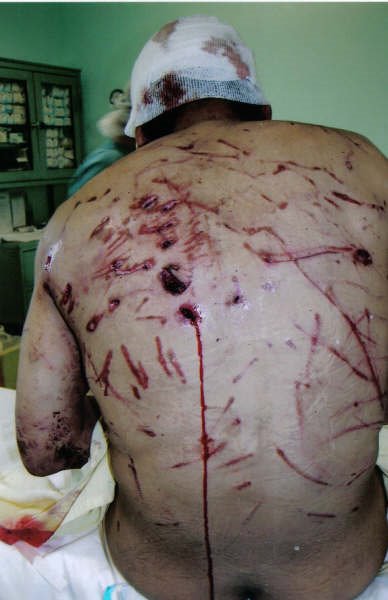
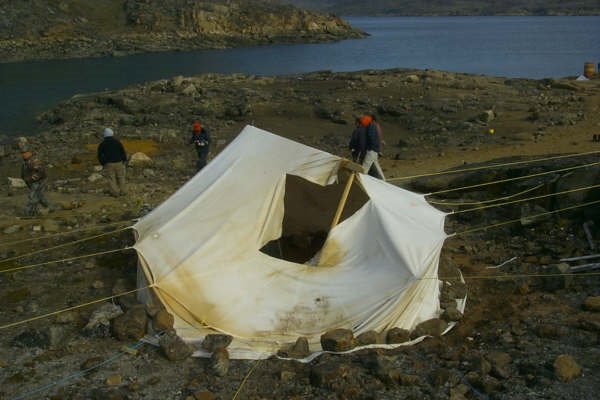
One dead polar bear. It is unfortunate that these mighty animals cross paths with humans. This is the usual result. This bear attacked unsuspecting campers near Kimmirut on Baffin Island. Some of the campers had been brutally injured by the bear before it was shot. I warn you that the following photographs are quite graphic. You may not want to see these images. 
Thursday, March 23, 2006
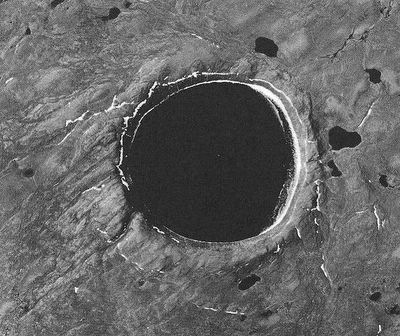
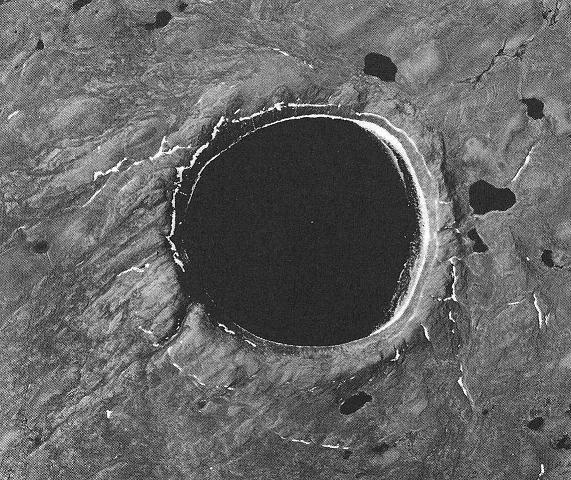
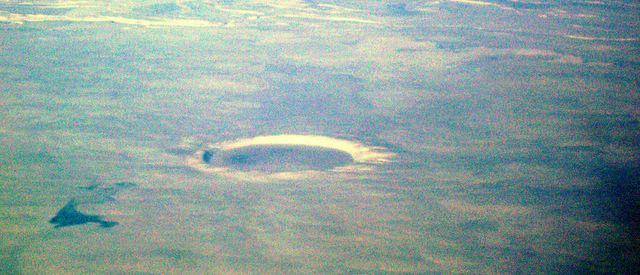
This is The Ungava Crater as seen from a high altitude aerial photograph. I didn't realize how large this crater actually is. Whenever I have had the rare opportunity to view this meteor crater, it was usually from 21,000 to 30,000 feet and many kilometers distant. It was hard to estimate the actual size of the crater from my viewpoint. I was amazed to find it's dimensions to be 3.44 Km in diameter and 445 meters in depth.
Tuesday, March 21, 2006
Ungava Crater
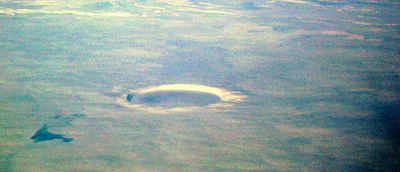
The Ungava Crater is an impact crater located in northern Quebec near Ungava Bay. The meteor crater is 3.44 Km in diameter and over 400 meters deep. I have seen it from the air several times now but have never been close to it on the ground. It would be a great place to explore in the short summer. The water in the crater bowl is a deep blue colour. This photograph shows the crater in it's usual arctic deep freeze state. The Ungava Crater is also known as the Chubb Crater or The Northern Quebec Crater.
Saturday, March 11, 2006
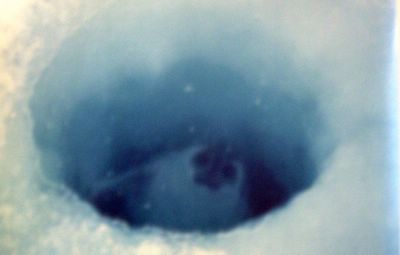
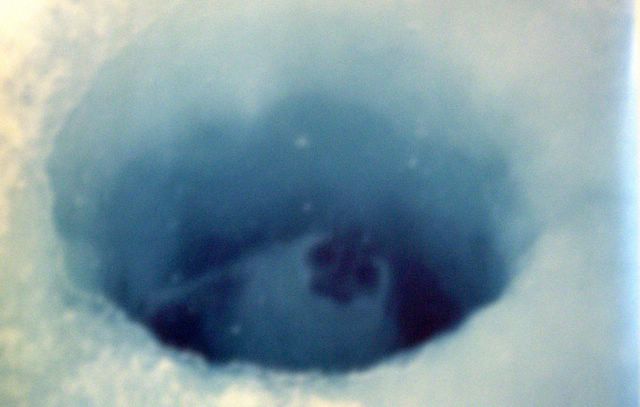
Come on in! The water is fine! Seals will keep several holes like this open in the sea ice. The seals need to come up for air from 4 to 10 times an hour. Sometimes they will use the holes to look around to see what is on the ice above them. Polar bears may hunt for seals by waiting near the breathing hole. Inuit hunters can stand motionless over a seal's breathing hole for hours in hope of harpooning the animal. Seals are an important food source for inuit across the arctic.
Saturday, March 04, 2006
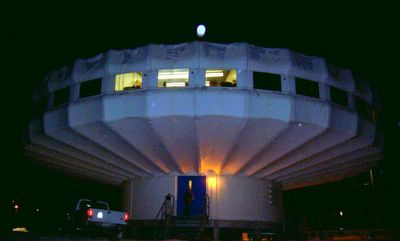
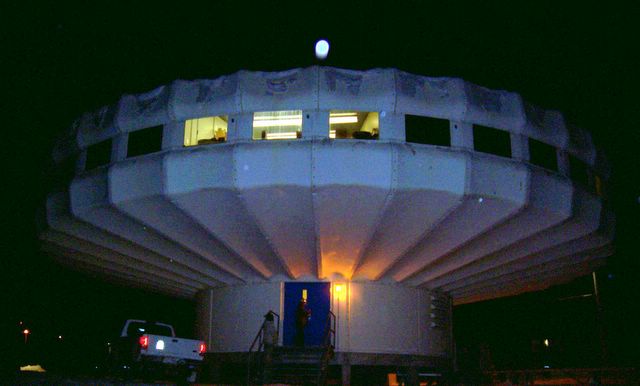
Here is an interesting building. It is located in Iglulik. The building was originally a research facility. It was built in the 1960's during an era when prefabricated fibreglass panels were the wave of the future. The building is now being renovated and will be used as an arctic wildlife research facility. Spiral staircases bring you up to a central common area and the various labs radiate from the building's centre.
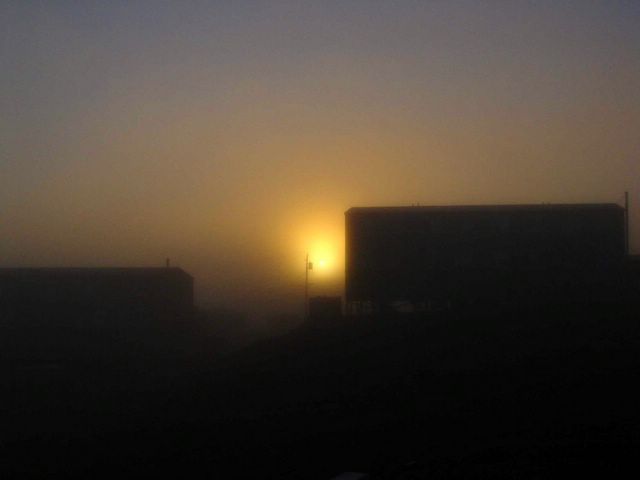
Starting off my morning in Hall Beach. These are the conditions just before we got the plane on it's way to Iglulik. The sun hasn't been seen for a long time. The sun looks like an atomic blast (In a way it is). Blowing and drifting snow was just the beginning of a massive blizzard covering much of Nunavut. We were to stay an extra day in Iglulik then on to Arctic Bay where we were once again weathered in.
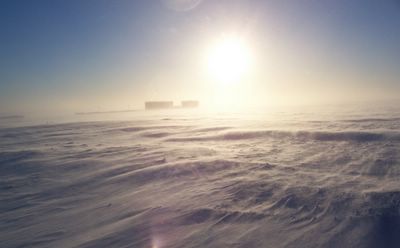
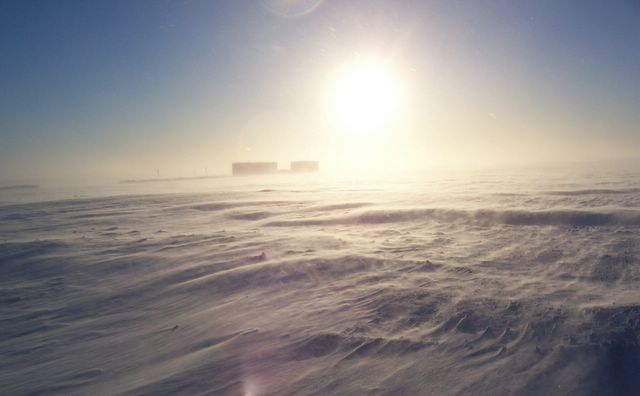
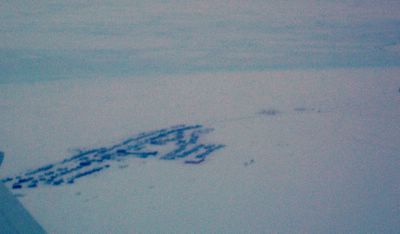
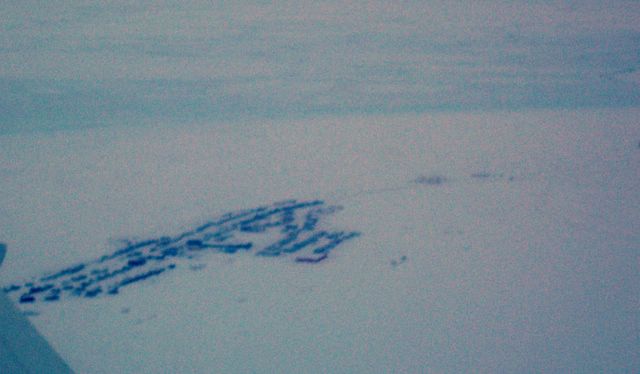
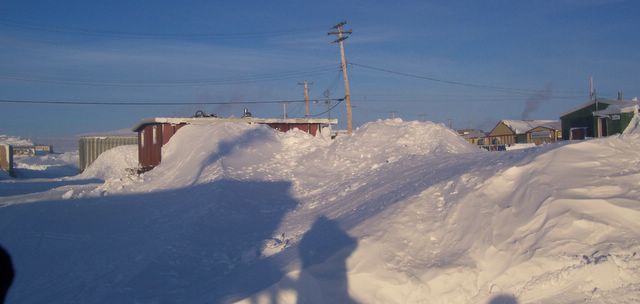
This is Hall Beach Nunavut. That's it that's all. Hall Beach is in the middle of polar bear country and is often visited by the bears. The community is small but surprisingly busy. The community suffered damge from very high tides. The sea ice kept piling up on the shore one day. It crushed many boats and threatened homes on the shoreline. One of the local people told me that they believe that there was a tsunami. She pointed out onto the sea ice and said that sea quakes occur there sometimes. I know that the tides were unusually high then as the moon was on it's closes approach to earth at the time. This caused very high tides around the world.
Monday, January 02, 2006
Happy New Year
The new year is here. How did we celebrate the new year? We had a bonfire. Sure it was minus 30C outside but we have a little cast iron pot belly stove complete with chimney, sitting outside on the tundra. We built a wall of snow bricks cutting them out of a drift with a saw. The blocks would squeek and squeal just as though they were made of styrofoam. The wall, when finished, stood five feet high and twenty feet long. It curved around the pot bellied stove in a semi-circle. The wall protected us from the wind while reflecting the fire's warmth back at us. There were twelve of us, feeding the fire, feeding ourselves, telling stories and playing backgammon. The fire raged and the hot toddies abounded. After several hours of fire, backgammon and hot toddies, we prepared for the strike of midnight. We looked out onto Frobisher Bay to see snowmobiles stretching in a line over two miles long. They were heading out onto the sea ice for the midnight ringing in of the new year. The snowmobilers formed a huge circle several miles out on the ice. There had to have been hundreds of them. I poured another rum toddy and watched the spectacle. At the stroke of midnight, we started to fire flares. Red flares, green flares and bright blue flares. Some of them would whistle while others would light the beach up as if it were daytime. We could hear people shouting and sounds of air horns, sirens and other loud noises. The new year is here! Happy New Year!
The snowmobiles rode around in a huge circle for several minutes. We could see others with fireworks and flares out on the ice. We watched as the machines broke the circle and started to head back into town. The two mile long line of headlights formed from shore to sea ice. The stars in the sky were bright and numerous. The northern lights seemed to dance in green, red and blue to welcome the new year. My toddy was not very hot anymore. I made sure that the next one would have more rum in it to avoid having my drink freeze in the -30C air. I cuddled up near the fire for a few more hours. A few more games of backgammon. Many more hot toddies. I looked at the wall of ice that we had made. The women had decorated it with ice candles of various colours. It really looked great! We were all tired and a bit drunk when we decided to let the fire burn out and call it a night. It was a very good New Year's Eve indeed.
The snowmobiles rode around in a huge circle for several minutes. We could see others with fireworks and flares out on the ice. We watched as the machines broke the circle and started to head back into town. The two mile long line of headlights formed from shore to sea ice. The stars in the sky were bright and numerous. The northern lights seemed to dance in green, red and blue to welcome the new year. My toddy was not very hot anymore. I made sure that the next one would have more rum in it to avoid having my drink freeze in the -30C air. I cuddled up near the fire for a few more hours. A few more games of backgammon. Many more hot toddies. I looked at the wall of ice that we had made. The women had decorated it with ice candles of various colours. It really looked great! We were all tired and a bit drunk when we decided to let the fire burn out and call it a night. It was a very good New Year's Eve indeed.
Subscribe to:
Comments (Atom)