Friday, July 15, 2005

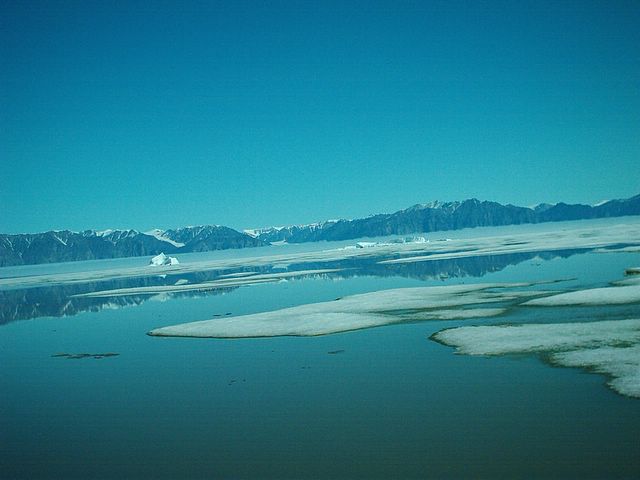
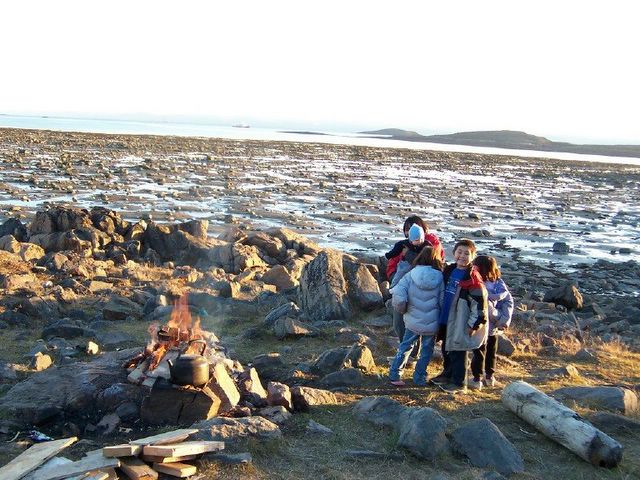
Pond Inlet pretty in the spring. Many polar bears can be found in this part of the world. They spend much of thier time hunting for seals on the sea ice. Posted by Picasa
The mountains are over 30 miles away but look so much closer. Many tourist make the mistake of trying to walk across the ice to get to the island. They soon find that it is much further than they had thought. Posted by Picasa
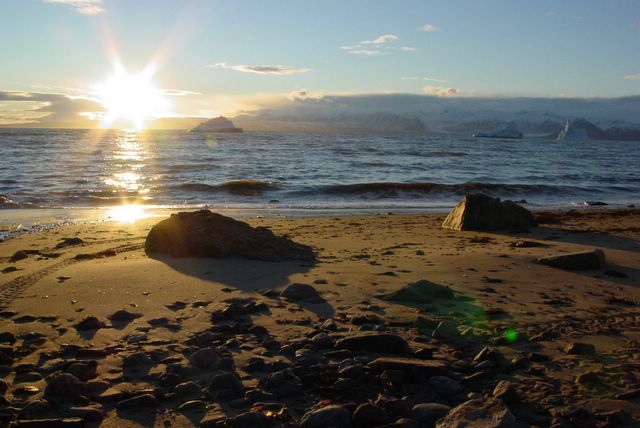
Sandy beach at the top of the world. Some of the "mountains" in the background are actually iceburgs. Here we see the sun setting. THe sun will not return in it's full glory for 6 months. The following weeks will become darker and darker untill 24 hours of darkness in December signify the official start of winter. Posted by Picasa

Thursday, July 14, 2005

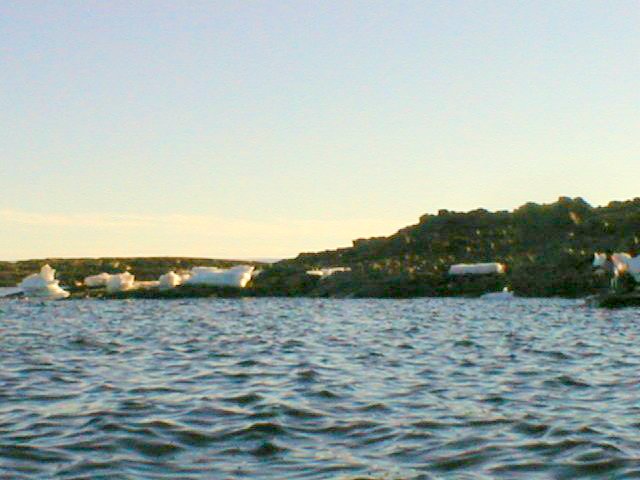
This pack ice will be left high and dry as the tide recedes. The ice on the left is about 15 ft. high. It is not wise to walk too close to the ice because when it is melting, the center of gravity changes. This can cause the ice to collapse or roll over. Posted by Picasa
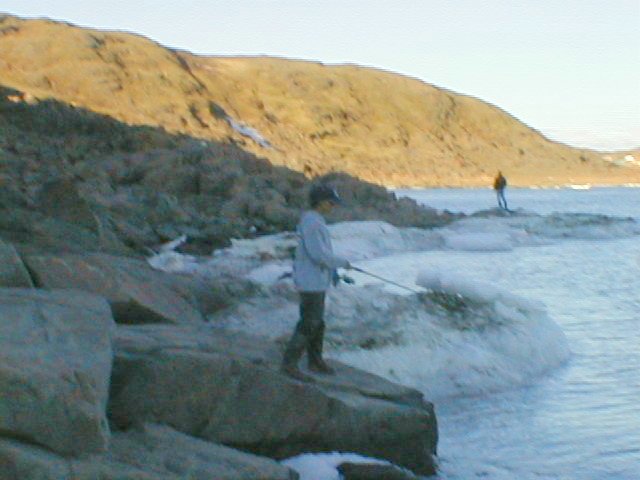
This is my son James fishing just as the high tide rolls in. Even in mid July, there is ice on the shore. The tide reached a height of 10.3 meters that day. Tides in Frobisher Bay can be as high as 12 meters. The water will recede a mile away at low tide a mere 6 hours after this picture was taken. Posted by Picasa
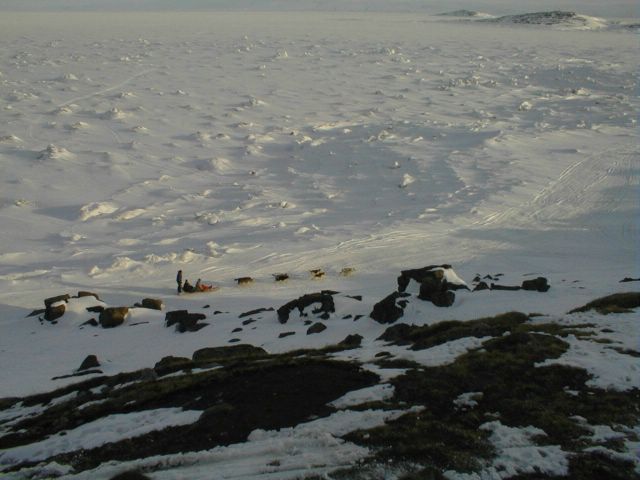
For all those who are sweltering in the hot southern sun, I thought that looking at this picture would help to cool you off. This picture was taken in May of this year. Mush! ( No one really says "mush" ) Posted by Picasa

Friday, July 01, 2005

The Sting

I have received many pieces of Email pertaining to bumble bees. Does the bee sting or not? A comment left on the site by Bill has indicated that bumble bees indeed sting and are capable of stinging multiple times. Most bees have a barbed stinger which imbeds into the victim which the bee is unable to extract. The bee will tear itself apart leaving the stinger and a pulsing venom sac behind. The bee perishes all for the good of protecting the colony. BIll has indicated to me that a true bumble bee has a smooth stinger and does not die after stinging.
So I have done some research. I was surprised to find that Bill is correct if we are talking about the female bumble bee. Here is a bit of information from an entomological web site dealing with bumble bee identification.

IDENTIFICATION

Bumble bees are large robust insects with black and yellow coloration. The bumble bee has a black or yellow hairy abdomen, which is a character that can be used to differentiate it from a carpenter bee, which has a black, shiny, hairless abdomen. The foraging bumble bee has a large pollen basket on each hind leg that is often loaded with pollen. The bumble bee queens are typically twice a large as workers or males. A female bumble bee has a pointed abdomen with a stinger. Males do not have a stinger and the tip of the abdomen is rounded.

So, Bill is correct (females) and so am I (males).
The foraging bees are female. They sting. I shall have to follow suit from now on and toss my golf clubs into the air running madly in circles screaming "Bee! Bee!" like the rest of the brave men of the arctic.

Wednesday, June 29, 2005

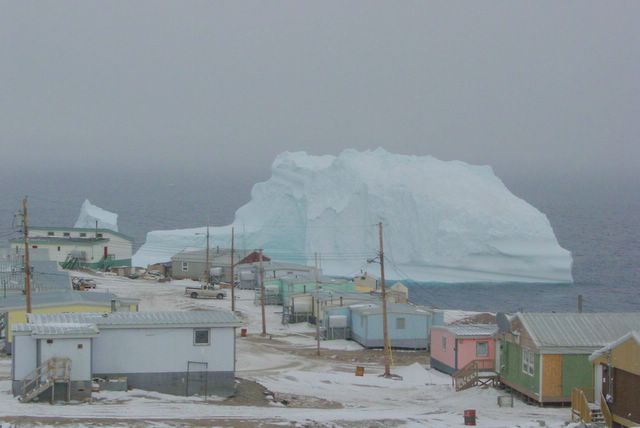
A big piece of ice floats past a few Pond Inlet homes. Posted by Hello

Tuesday, June 28, 2005

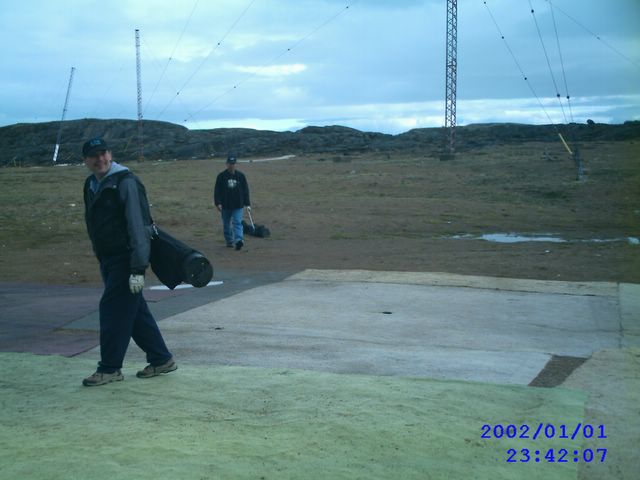
Wet sandy carpets make up the 4th hole played in this games known as Al's Hole. Posted by Hello

Monday, June 27, 2005

Bee

Baffin Island has bees. The bee may not be a true bee but everyone here calls them bees. Most refer to them as bumble bees. I believe that a true bumble bee is not capable of stinging. The Baffin Island bee is said to sting although I have never seen anyone get stung. The bee is a large insect bee-ing about 3/4" long. It has a spikey look to it as the yellow and black hairs jut outward from it's abdomen. On occasion I will spot a bee that doesn't belong here. It would be an insect that was brought here on a ship or aircraft as a stow away. I had seen a paper wasp in Pond Inlet. Pond Inlet is far above the arctic circle and far above the treeline. I do not think that these insects will survive after being unwitingly brought to the arctic. Those insects need forested areas and warmer temperatures. The arctic bumble bee is right at home on the tundra.
I was curious to know what has been learned about the local bumble bees and was astonished to find many interesting facts. First of all, there are five species described for arctic bumble bees. They all fall into the subspecies of "alpinobombus". Bombus is such a suitable name for a bumble bee, somehow. Bombus polaris is probably what the little creatures that can be found here are called. There is also species of bombus hyperboreus, bombus balteatus and bombus neoboreus buzzing around. There certainly is lots of bombus among us.
I am pleased with my new found knowledge. As I walk about our home made Tundra golf course, I shall surely take note of whether 'tis a bombus polaris or a bomus hyperborialis buzzing 'bout. I will assert that the bee doesn't have a stinger and cannot harm a human as is true with bumble bees of the south. I know that the people here, that run away in fear, screaming "Bee! Bee!", will not believe me. There are many falsehoods attached to the bee. Honestly, I will never understand how some of the Inuit men I know, run frantically away from the little arctic bumble bee. These men, most who would brave an arctic blizzard to hunt down big game with nothing more than a spear, fear these insects. Why? The bee seems to be an arctic boogieman. Tales of eggs being laid in your ears or of larvae growning under your skin and other such heebiegeebie stories that make you go ewww. I only see a bee collecting pollen. An arctic bee.

Tuesday, June 21, 2005

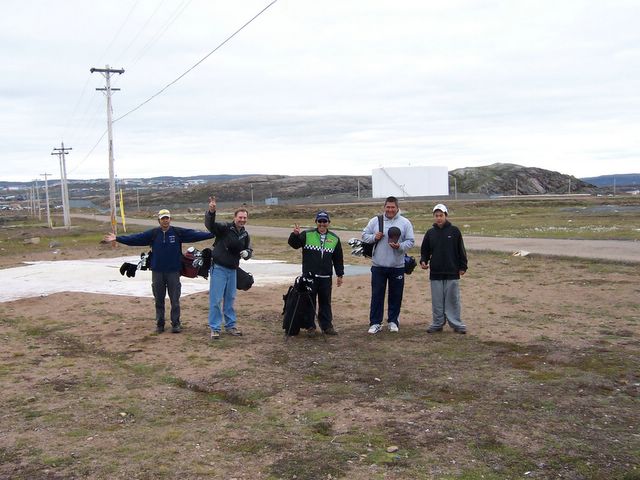
Tundra Golfers of July 2004.
Notice the "green" in the background. The putting surface is completely surrounded by sand and gravel. These conditions have not stopped these men from breaking 80 in an 18 hole round. When it comes to Tundra Golf, these guys are pretty good. Posted by Hello

mosquito

The longest day of the year. Yes, today is the longest day of the year. Each day shall be several minutes shorter from this point onward. It will not be noticable untill late July when it once again will start to become dark at night. Right now, we get about 22 hours of day light interrupted only by twilight. The midnight sun allows for me to play golf at any hour of the day or night. I anticipate the July 1st "Canada Day" holiday. We always have a tournament along with a picnic. I shall bring the tent down to the Sylvia Grinnel River along with plenty of food and fishing gear. The day will be full of fishing, eating and of course, golfing.
Along with the midnight sun, the summer brings on the hordes of arctic mosquitos. Skeeters, little vampires or call them what you will, will descend down upon us by the billions. I saw a mosquito this morning. It is +3C and the biting bugs are starting to come out.
Baffin Island has large mosquitos and each little critter has a fur coat. You can buy a souvenier mosquito "pelt" mounted on a tongue depressor at the local gift shop. Some T-shirts claim that the mosquito is our national bird. There is also a tiny leg trap sold as a mosquito trap. Catch a bug without ruining the pelt.
These biting bugs will be with us for most of the summer. In July, they can be a plague. I have seen dogs completely covered in mosquitos. The bugs will swarm around the animals' nostills and make it difficult to breathe. I have seen groups of caribou running about trying to rid themselves of the torment of the bug. Many caribou will look for persistant patches of snow that they can stand on. Less mosquitos above the cooler snow patch. Even polar bears can be pestered by these little creatures. The bears will just jump into the freezing waters of Frobisher Bay in order to rid themselves of the bugs. As much as we all hate the mosquito, they are an important part of the arctic food chain. Fish will be jumping out of the water to eat them. Birds will feast upon the little vampires. Spiders will take thier fair share. For us humans, we will just have to tolerate them.
I think I have an itch.....
Where is that after bite lotion?

Thursday, June 16, 2005

Map of Nunavut,

CLICK HERE TO WARP TO NUNAVUT

Igloolik Golfer

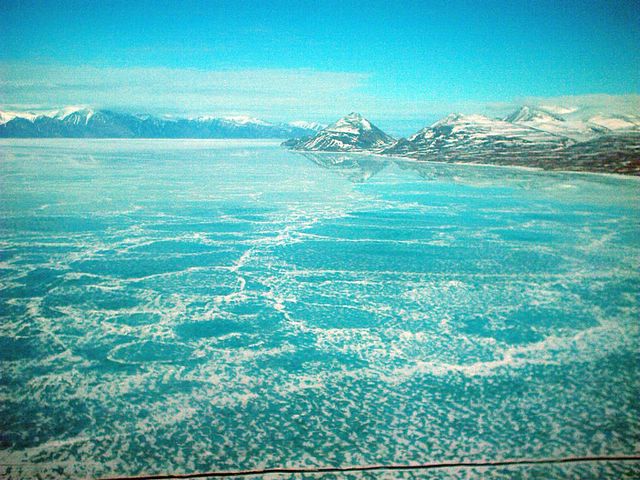
I just returned from Igloolik. It was a balmy 2 degrees Celsius and very sunny when I had first arrived in Igloolik. There are still many patches of ice and snow strewn across the tundra. The sea ice looked beautiful from the air as I approached the landing strip. The ice displays a myriad of colours and hues of blue and turquoise. The colours change as the sun moves around in the sky. The sun moves around in the sky, without setting, at this time of year. Igloolik lies well above the arctic circle. (See the map at:
http://www.hallbeach.com/map-of-nunavut-map.htm)
The land is very flat in Igloolik. You can look in all directions across vast expanses. Landmarks are few and distant. The local people are very friendly. Many of the local Inuit were out camping or waiting for the goose egg harvest. There were many hunters on the sea ice working on providing thier families with fresh seal or arctic char. It is a peaceful place in the late spring.
I was walking around the streets of Igloolik when I spotted a young Inuit boy walking in an open area with a 3-wood thrown over his shoulder. He was looking for a golf ball. I just had to smile and think that maybe this young boy shall find a piece of rocky, gravely tundra and build a golf course on it. Igloolik is very rocky but there are patches of moss and soil here and there.

After I had finished my business in Igloolik, I had to return home to Iqaluit. When I got home, I had to build this electronic thingamagink for this sparky to install in Igloolik. I had to ship it to him right away. I put a dozen golf balls in the package. Hey, Igloolik is a small town and I know that those golf balls will get into the right hands.

Monday, June 13, 2005

49...

Ok, so I shot 49 strokes in a nine hole round. I must explain that I had lost 3 balls in the muskeg. They shall be found in some future civilization, as fossilized impressions. Upon thier discovery in the distant future, further excavation in search of artifacts shall be inspired. They shall find many hundreds of globular dimpled mineralized impressions. I know because I have lost over 500 golf balls in the muskeg at the tundra course. Many other tundra golfers have lost as many. So three extra strokes were due to the lost ball in the arctic spring golf ball eating swamp.
Net, 46 strokes.
I must also explain that hitting a ball off of wet moss is akin to hitting a ball off of a half frozen wet sponge. Many good lies were actually the worst lie you could end up with. A normal golf swing would require the golfer to hit down on the ball. Hitting the ball with a slight downward trajectory is what actually gets the ball in the air. That is if you are hitting a golf ball off a fairway on a carefully designed and properly landscaped stretch of land specifically made for the game of golf. I have no such luxury. The tundra course predates any other golf course by several million years. This predates landscaping, botanical agriculture, engineering and Burmuda Grass Greens. The result is that in some cases, hitting down on the ball just drills it into what looked like dry grass but was actually moss with the consistancy of green mud. The ball simply gets driven underground never to be seen again. We allow moving the ball to a spot where the ball is at least playable. I could have exercised that option on two occasions. I was lying on the dreaded green mud moss but figured that I could just pick the ball off of the moss. The ball drove into the ground and had to be retrieved. I of course, moved off of the golf ball eating moss on my next attempt at approaching the hole. Experience should have told me that I could not hit that shot. I threw away two strokes there, net 44.
The "green" on every hole is made of different pieces of carpet. Some of the carpets are shag. Some are indoor outdoor types. All of them are soaking wet and splayed with sand and gravel. We allow a quick sweep to remove pebbles and sand from the carpet. We even allow time out when a squeegee is needed to rid the area surrounding the hole of water. I was putting on a wet shag carpet with many pebbles and simply didn't clean away the debris. I was impatient. The putt was only 10 feet or so but I really had to strike it hard. A tall rooster tail of water sprayed up from behind my ball. I saw that it was going too slow to reach the hole. Then it hit the pebble and just stopped. A foot from the hole. The hole was rapidly filling up with melt water. There is still plenty of large snow drifts melting. All of the snow is gone except for the reminants of great snowdrifts that formed during the winter, from September to May. I missed six strokes because of melt water and pebbles. Net 38.
38. That is more like it.
I am happy with 38. Not an exceptional score but a rather good one.

Saturday, June 11, 2005

Pre-season practice.

Today is a sunny day with light winds. An expected high of 8 degrees Celcius is in the forcast. I hear that there are three holes open at the Tundra Golf course. The rest remain buried in several feet of ice and snow. It is time to get out the golf clubs and dust them off.
I intend to play a nine hole round today. We shall play the three open holes thrice. The dress code of the day will include rubber boots, a good sweater, a cap and dark sunglasses. I will have to include a broom in my golf bag as the "greens" will undoubtedly be covered in sand and gravel. There will be lots of casual water and mud to deal with. I also must use fluorescent coloured golf balls in case I slice one into the snow.
The warm air may be uncomfortable at times as I am still climatized for the arctic winter. It has been a long and cold winter. There were days when the windchill was recorded at -76 degrees Celcius (That's -104.8F for you southern folk). Darn cold to be sure. So it is not a wonder that when I step out into the sun at +8C, I feel as though I am in the tropics.
This game we are going to play today is only a pre-season warm up. Snow and mud shall make some shots interesting. The constant sunlight may allow a midnight round as well. That depends on how many Rum and Coke I swill at the local Royal Canadian Legion tonight.
Now, where did I put that snow wedge?

Wednesday, June 01, 2005

Summer in the arctic. Frobisher Bay at low tide. Posted by Hello

Tuesday, May 31, 2005

More arctic ice golfing in Cambridge Bay, Nunavut.

Click here to warp to Cambridge Bay Nunavut.

"FORE"


Golfing on the sea ice in Cambridge Bay. The Peter Gzowski Invitational Golf Tournament.

Here are a few pictures of the sea ice golfers. This year there were no polar bears to contend with.

There are many links to some of Nunavut's websites offering information and entertainment with an arctic perspective of life.

Saturday, May 28, 2005

Stranded on an ice pan

One of Iqaluit's hunters was stranded on an ice pan today. Mr. Chris Gerioux was stranded on the sea ice when a section of the ice floe broke off from the ice pack and drifted out to sea. Mr. Gerioux was stranded along with his snow mobile for over 13 hours.
The ice pan was roughly 100 ft. by 50 ft. in size but began to break up as the water became rough. The ice pan broke in half and threatened to disintegrate leaving Mr. Gerioux to drown in the freezing waters of Frobisher Bay. Chris was eventually spotted by a passing hunter. He was rescued and his snowmobile was salvaged. Chris is very fortunate to be alive. The tidal currents would have surely floated him out into high seas where he would have met an icy fate.

Monday, May 23, 2005

One Survives. Official Report.

Nunatsiaq News

Facts VS the Grapevine.


Here is the official local news report on the tragic loss of one of our own. Previous information was retrieved from the grapevine. It sure is strange how many different versions of the story came out.